
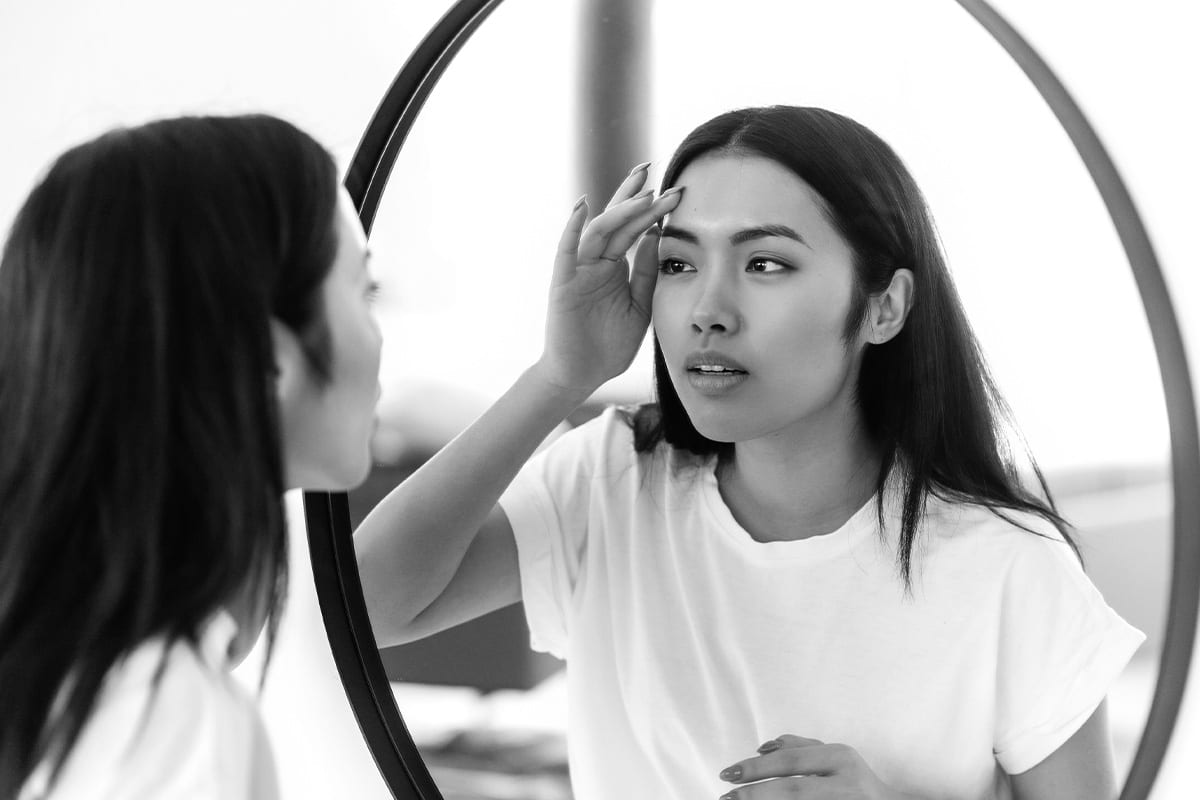
You take a selfie.
Look at it.
Flip it.
Zoom in.
And suddenly you notice something you can never unsee:
Wait…why is one eyebrow higher than the other?!
Welcome to the Asymmetry Club.
Membership: basically everyone.
One eyebrow may sit higher. One eye may look slightly larger. One cheek may be fuller. One side of your smile may pull higher.
And before you start analyzing every photo you’ve taken since 2009, here’s the good news:
Perfectly symmetrical faces don’t really exist.
Facial asymmetry is completely normal. But sometimes the difference between your eyebrows can become more noticeable with age, facial expressions, muscle activity, or even previous aesthetic treatments.
Let’s talk about what’s actually happening.
First: Your Eyebrows Aren’t Twins
Think of your eyebrows as sisters—not identical twins.
Your underlying facial anatomy is naturally different from one side to the other.
Small differences can exist in your:
- Brow position
- Eye shape
- Eyelid anatomy
- Forehead muscles
- Facial bones
- Fat distribution
- Muscle strength
You may have had an uneven brow your entire life without realizing it.
Then one day someone takes a photo from a different angle and suddenly…
You see it.
And now you can’t stop looking at it.
Sorry.
Your Facial Muscles May Be the Real Culprit
Your eyebrows don’t move by themselves.
Several muscles around the forehead and eyes influence where your brows sit and how they move.
The frontalis muscle, for example, helps elevate the eyebrows.
But here’s where things get interesting:
You may naturally use one side more than the other.
Try this:
Look in the mirror and raise your eyebrows.
Does one shoot up higher?
Now smile.
Does one eye squint more?
Frown.
Does one side pull differently?
Most people have a dominant side of facial expression.
Over thousands of expressions—and eventually millions over a lifetime—those differences can become more noticeable.
One Eye May Be Doing More Work
Sometimes a higher eyebrow isn’t simply an eyebrow problem.
Your body may actually be compensating for something happening around the eye.
For example, if one eyelid naturally feels heavier, you may subconsciously use your forehead muscle to lift that eyebrow higher.
You aren’t intentionally doing it.
Your face has simply figured out a way to help open the eye.
That’s one reason it’s important to evaluate the whole upper face instead of looking at the eyebrow alone.
Why Does My Eyebrow Asymmetry Look Worse in Photos?
Phones have done absolutely nothing for our facial-asymmetry anxiety.
Camera angles, lighting, lens distortion, head position, and facial expressions can make subtle differences look much more dramatic.
And then there’s the front-facing camera.
You’re accustomed to seeing your mirror image every day. When a photograph flips your face, it can suddenly look unfamiliar.
That doesn’t necessarily mean everyone else sees dramatic asymmetry.
Your brain simply isn’t accustomed to seeing your face that way.
So before declaring an eyebrow emergency based on one selfie…
Put the phone down.
Aging Can Make Asymmetry More Noticeable
As we age, our face doesn’t necessarily change evenly.
Skin elasticity changes.
Facial volume changes.
Bone structure changes.
Muscles continue pulling in slightly different directions.
And your eyebrows may gradually change position.
If one side was already slightly different, those changes can make the asymmetry more noticeable over time.
That’s why you might suddenly think:
“My eyebrows were never uneven before!”
They may actually have been.
You’re just noticing the difference more now.
Can Neurotoxins Help Uneven Eyebrows?
In certain situations, yes.
When eyebrow asymmetry is primarily related to differences in muscle activity, carefully placed neurotoxin may sometimes help create better balance.
The key word is:
Carefully.
Treating eyebrow asymmetry isn’t simply about injecting the same amount on both sides.
In fact, treating both sides identically can sometimes make an existing asymmetry more noticeable.
An experienced injector evaluates how your eyebrows sit at rest and during movement.
We may ask you to:
- Raise your eyebrows
- Frown
- Smile
- Squint
- Relax completely
We’re essentially watching how your facial muscles communicate with each other.
Because your face is dynamic.
And your treatment should be too.
Sometimes We Intentionally Treat Each Side Differently
This surprises people.
They’ll ask:
“Why did you put more units on one side?”
Because your face isn’t symmetrical.
If one muscle is significantly stronger than the other, using identical treatment on both sides may not create the most balanced result.
Depending on your anatomy and treatment goals, an injector may adjust placement or dosing from one side to the other.
Customized treatment beats cookie-cutter treatment every time.
Can Neurotoxins Cause an Uneven Brow?
They can sometimes contribute to temporary brow asymmetry.
Because neurotoxins alter muscle activity, small differences in anatomy, dosing, placement, or how each side responds may result in one eyebrow appearing higher than the other.
Sometimes this creates the famous:
Spock brow.
You know the look.
One part of the eyebrow arches dramatically upward while the rest stays relatively still.
Fortunately, depending on the cause, some asymmetries can sometimes be adjusted after the treatment has had time to fully settle.
This is one reason providers generally want you to wait for the treatment to take full effect before evaluating the final result.
But Not Every Uneven Brow Should Be “Fixed”
This may be our favorite part of the conversation.
Your face doesn’t need to be perfectly symmetrical.
In fact, trying to force perfect symmetry can sometimes make a face look less natural.
The goal of aesthetic medicine should not be to turn your face into a mathematically identical left and right side.
The goal is balance.
Maybe one brow stays slightly higher.
Maybe one cheek is naturally fuller.
Maybe your smile pulls a little stronger on one side.
That’s part of what makes your face look like your face.
When Should You Have Sudden Facial Asymmetry Checked?
There’s an important difference between longstanding cosmetic asymmetry and a sudden change.
If one side of your face suddenly droops or becomes weak—especially if you also experience difficulty speaking, numbness, arm weakness, severe headache, vision changes, or other new neurological symptoms—seek urgent medical evaluation.
That’s not the kind of asymmetry we’re talking about here.
Cosmetic facial asymmetry is generally something you’ve had gradually or for a long time.
A sudden neurological change should not be treated as a cosmetic issue.
The B.TOX.BAR Philosophy: Balance, Not Perfection
At B.TOX.BAR, we don’t believe your left side needs to perfectly match your right side.
We look at your face at rest.
We watch you animate.
We evaluate muscle strength.
We look at your eyes, eyebrows, forehead, and overall facial anatomy.
And then we decide whether treatment would actually improve the concern—or whether that tiny difference is something we should simply leave alone.
Because sometimes the best treatment decision is:
Don’t touch it.
And sometimes a small, strategic adjustment can make the entire upper face appear more balanced.
Either way, the goal is never perfection.
It’s natural movement, thoughtful treatment, and results that still look completely like you.
So if you’ve recently discovered that one eyebrow is higher than the other…
Congratulations.
You’re officially a member of the Asymmetry Club.
Don’t worry.
We’re all in it.
